


As a financial advisor, one of the most frequently asked questions I encounter is about the potential impacts of presidential elections on financial markets. Every few years, clients naturally tend to worry about the volatility and uncertainty that elections bring and how it might impact their financial standing.
While it can feel like elections cause more market fluctuations, understanding the underlying dynamics can help investors confidently navigate these periods. We will continue to experience elections every few years, so it’s wise to look at the data to see what we can learn.
Myth #1: The markets perform better under [insert political party name].
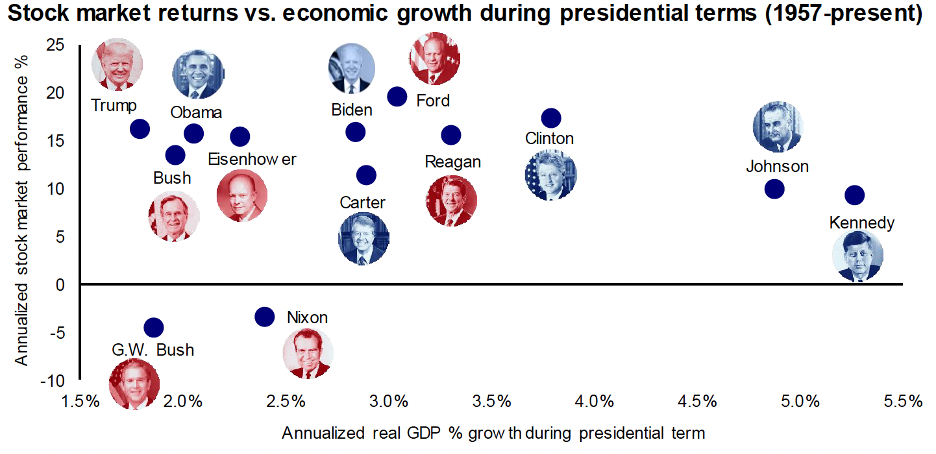
Voters and sometimes even the candidates themselves will argue that the markets will perform better under one party’s administration than the opposition. However, according to Invesco, from 1957 to the present, the data show neither party (Republican or Democrat) can claim superior economic or market performance. Across most administrations, the stock market posted positive returns, and the range of market returns has been largely similar since 1961. Stock market returns versus economic growth only saw negative performance under George W. Bush and Richard Nixon. We should note exceptions include presidencies that ended in recessions, but recessions are mostly unpredictable and are not tied to a particular party.
Furthermore, the data also show that the best-performing portfolios in the past 123 years are “bipartisan” in that they stay invested during both Democratic and Republican administrations. Investing based on partisanship causes portfolios to underperform, to the tune of millions of dollars.
Myth #2: This is the “most important election of our lives.”
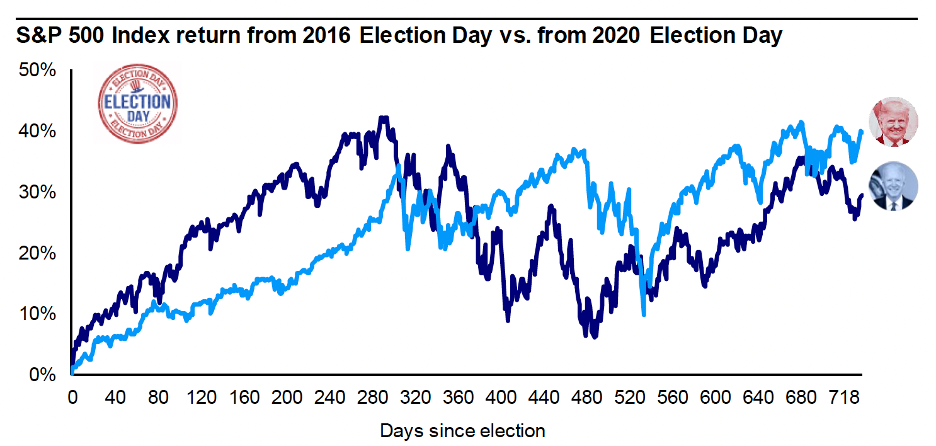
Presidential elections are important, of course. But each election is touted in the media as the most important thus far. While people’s personal views on the importance of elections are certainly within their rights, the markets don’t seem to agree and perform similarly from election to election. For example, the markets performed exceedingly similarly during the first years of Trump and Biden’s first terms. Neither election, from a market standpoint at least, was more significant than the other.
Myth #3: Election outcomes in industries and sectors are predictable.
One thing that drives market uncertainty is the behavior of the markets by sector and/or industry. Many speculate what may happen to the healthcare, energy, and tech industries (among others) depending on which party gains control of the White House. And it makes sense to wonder since many issues discussed on the campaign trail include regulated industries. However, these predictions are rarely true.
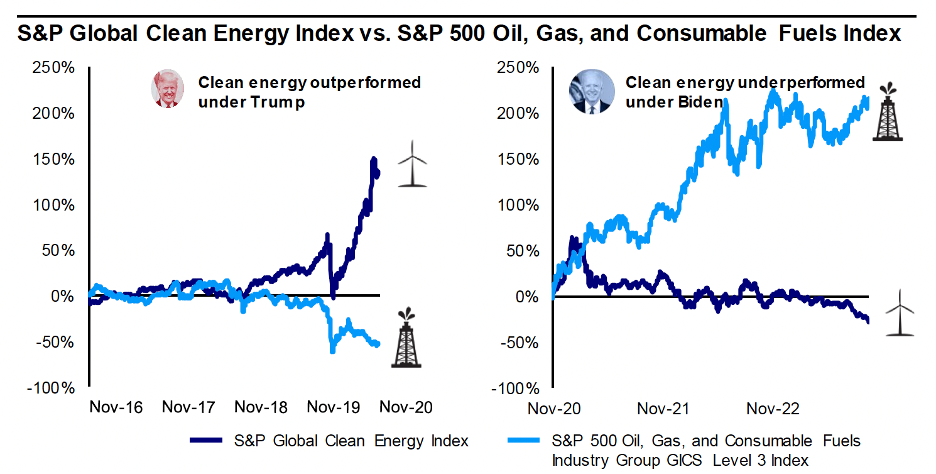
For example, contrary to what many would guess, clean energy outperformed under President Trump and underperformed under President Biden. While each industry will be curious about how the president and changes in regulation may impact their stocks, the data shows that hard and fast assumptions and predictions rarely come true.
Myth #4: The U.S. economy will be “fixed” under [insert candidate’s name here].
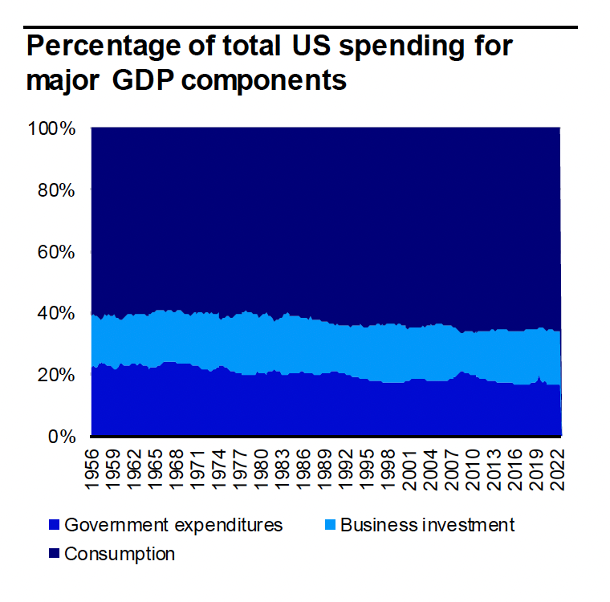
This one hits close to home, especially in recent years. And it’s normal for us all to be hopeful for a strong economy. However, data show the composition of the U.S. economy has been consistent since the 1950s, meaning even a single-party rule hasn’t resulted in significant change. While some variations will happen, of course, and the economy ebbs and flows, so far politicians haven’t been focused on completely re-engineering our economy.
Myth #5: [Insert party name here] is more fiscally responsible than [other party].
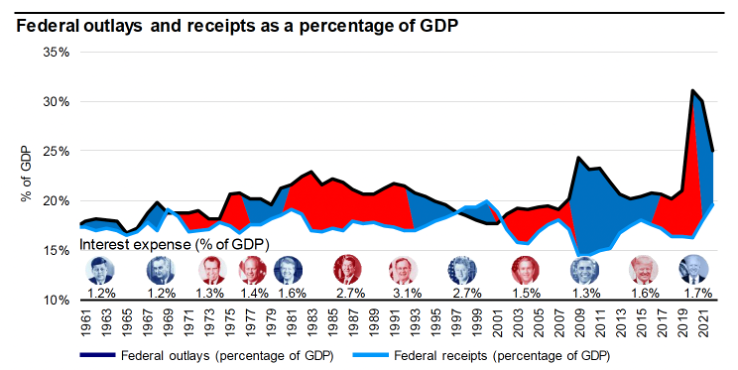
As you’re probably catching on by now—data show that neither party is consistently better when the nation’s finances over the other. Federal spending has outpaced taxes and other sources of income in most years and across most administrations, regardless of party. While government spending should be executed responsibly, and there’s certainly room to argue things could improve, remember: the data doesn’t support that this is dictated by which party has control.
So, What Should We Focus On?
Those are just a few of the myths we hear about presidential elections and their impact on the markets, but of course, there are more. But, with much of the data essentially downplaying elections’ significance when it comes to investing, what are the things we can do to set ourselves up for success? Well, it’s to get back to basics and focus on the fundamentals of investing:
To manage the potential risks and opportunities during election years, consider the following strategies:
- Diversification: Maintain a well-diversified portfolio to spread risk across different sectors and asset classes. Diversification can help mitigate the impact of market volatility on your overall portfolio.
- Focus on Long-Term Goals: Stay focused on your long-term investment goals rather than reacting to short-term market fluctuations. Historical trends show that markets tend to recover from election-related volatility. Unless you are planning on needing your investment funds during an election year, remember it’s a marathon—not a sprint.
- Monitor Economic Indicators: Keep an eye on key economic indicators such as interest rates, inflation, and employment data. These factors can provide insights into the broader economic context and help inform investment decisions.
- Stay Informed: Don’t let the noise of an election distract you away from watching emerging companies, technologies, and other developments that are worth investing in. Elections come and go, so keep your eye on the ball if you’re an investor who likes to look for the latest and greatest.
While presidential elections can bring periods of uncertainty and increased market volatility, they also present opportunities for informed investors. By understanding historical trends, sector-specific impacts, and maintaining a long-term perspective, you can navigate the complexities of election years with confidence. Remember, the key to successful investing is staying informed, diversified, and focused on your long-term goals.
If you have specific concerns about how an upcoming election might affect your portfolio, feel free to reach out for personalized advice. Together, we can develop a strategy that aligns with your financial objectives and helps you weather any market storms that may arise.
Source: People Care About Elections. Markets Don’t. Invesco, 2024.
Past performance does not guarantee future results. Diversification does not assure or guarantee better performance/profit and cannot eliminate the risk of investment losses in declining markets. Asset allocation does not assure or guarantee better performance/profit and cannot eliminate the risk of investment losses in declining markets. Investments are subject to market risks including the potential loss of principal invested.